
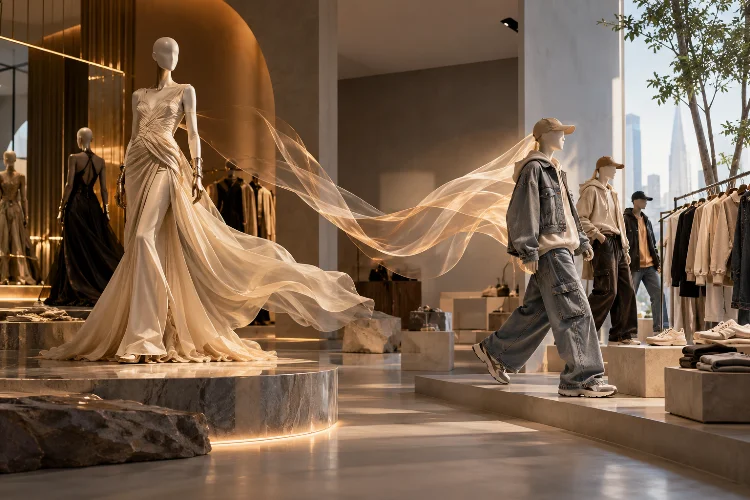
A look appears on a luxury runway in Paris. A few months later, similar colours, proportions, or styling ideas appear at mainstream retailers. That sounds like the classic fashion story – but today, trends can travel in the opposite direction just as easily.
Sneakers, oversized clothing, workwear, skate style, and other ideas that developed outside traditional luxury circles have repeatedly influenced high-fashion collections.
At the same time, social media allows trends to jump between communities and price levels with almost no obvious starting point.
Also Read
This movement is known as trend diffusion across luxury and mass markets.
Fashion researchers have traditionally explained diffusion through trickle-down, trickle-up, and trickle-across theories. These models remain useful, but digital culture has made the process far less linear.
Recent research has even proposed updated “triple-trickle” frameworks that incorporate media and technology into fashion adoption.
Understanding how trends move helps designers, retailers, marketers, and consumers make sense of why one aesthetic becomes global while another disappears within weeks.
What Trend Diffusion Means in Fashion
Trend diffusion describes the process through which a fashion idea spreads from one group of people to another.
That idea could involve a silhouette, fabric, colour, accessory, styling technique, or even a broader lifestyle aesthetic. As more groups adopt it, the trend moves through different stages of the fashion cycle.
Fashion education has traditionally described three major directions of movement: trickle-down, trickle-up, and trickle-across. These theories explain how adoption can move between social classes and peer groups rather than assuming every trend follows the same route.
What makes modern fashion interesting is that all three can happen at the same time.
A luxury house may introduce a new silhouette, influencers may make it visible, mass retailers may interpret it at lower price points, and consumers may then create entirely new styling combinations that feed back into designer collections.
Trend difussion has become a loop rather than a straight line.
Trickle-Down: When Luxury Influences the Mass Market
The trickle-down model is probably the most familiar version of fashion diffusion.
In this model, styles begin among elite or high-status groups and gradually spread to broader markets. Historically, social prestige played an important role: consumers adopted clothing associated with wealth, status, or cultural influence.
Luxury fashion still operates this way in many cases.
A runway collection can establish a new shape, colour palette, handbag proportion, or styling direction.
Fashion editors, celebrities, buyers, and high-profile influencers increase its visibility. Mainstream brands then interpret elements that appear commercially promising.
The mass-market version is rarely an exact copy. Details may be simplified, materials changed, and construction adjusted to meet different price points.
Luxury therefore often works as a creative laboratory.
It can introduce exaggerated ideas that eventually become more wearable as they travel downward through the market.
However, modern luxury does not completely control this process anymore. Consumers now encounter thousands of competing style signals through digital platforms, making top-down influence only one part of the picture.
Trickle-Up: How Street Culture Reaches Luxury Fashion
Fashion can move upward just as powerfully.
The trickle-up theory describes styles that begin within subcultures, working communities, youth movements, or street culture before being adopted by higher-priced fashion brands.
Streetwear provides an obvious example.
Sneakers, hoodies, graphic T-shirts, skate references, utility garments, and casual silhouettes were not invented by luxury houses. Many gained cultural relevance in communities far outside traditional high fashion before designers brought them onto prestigious runways.
This process reflects an important shift in cultural authority.
Luxury brands increasingly look beyond elite consumers for inspiration. Youth movements, musicians, athletes, digital creators, and local subcultures can now influence what eventually appears in premium collections.
Research on sustainable-fashion adoption similarly argues that traditional one-directional theories are becoming insufficient and proposes a framework incorporating multiple trickle effects alongside media and technology.
That means an inexpensive or functional garment can gain cultural meaning first – and luxury positioning later.
Price is not always where fashion influence begins.
Trickle-Across Makes Fashion More Horizontal
Trickle-across, sometimes called horizontal diffusion, describes trends spreading between groups at similar social or market levels.
This has become especially important in modern fashion.
Consumers no longer need to wait for an elite style leader to introduce every new idea. People observe friends, online communities, micro-influencers, colleagues, creators, and consumers who share similar lifestyles.
A styling idea can therefore spread horizontally across thousands of people before major fashion companies notice it.
Social platforms make this process extremely fast.
Someone can post an unusual outfit in Seoul, Copenhagen, Jakarta, or New York, and consumers thousands of kilometres away can reinterpret it almost immediately.
The result is a more decentralised fashion system.
Trends may emerge simultaneously in several communities, making it difficult to identify one creator or original market level.
This also helps explain why trend forecasters increasingly study consumer-generated content alongside runway collections and retail sales.
Fashion leadership is now distributed across many groups.
Social Media Has Compressed the Diffusion Timeline
Before digital platforms, fashion diffusion could take several seasons.
Luxury collections were shown, fashion publications interpreted them, retailers developed products, and consumers eventually encountered mainstream versions.
Today, the gap can be dramatically shorter.
Runway images circulate online almost immediately. Creators discuss collections within hours, consumers identify emerging details, and retailers can use digital data to track interest quickly.
Social media also increases the visibility of trends that originate outside luxury.
A small aesthetic community can suddenly reach millions of users if its visual language performs well on a platform. From there, brands may respond with products designed around the growing demand.
This changes the relationship between influence and market size.
A niche group does not need enormous purchasing power to create cultural impact. It mainly needs enough visiblity to influence the people who design, promote, or buy products.
Research on fashion adoption increasingly considers technology and media essential components of modern diffusion rather than simply communication channels added after trends develop.
Luxury and Mass Markets Influence Each Other
It is tempting to imagine luxury and mass-market fashion as two separate worlds.
In reality, they constantly exchange ideas.
Luxury brands benefit from observing the speed, accessibility, and cultural reach of mass fashion. Mainstream retailers, meanwhile, often translate luxury aesthetics into more accesible products.
Collaborations make the relationship especially visible.
Designer partnerships with mainstream retailers can temporarily bring luxury-associated design language to a much wider audience.
At the same time, collaborations with streetwear labels, artists, athletes, or youth-oriented brands allow luxury companies to reach communities outside traditional luxury circles.
The broader luxury market has also become increasingly interested in younger and more diverse audiences.
McKinsey and The Business of Fashion have documented how luxury brands use collaborations and cultural partnerships to expand relevance beyond traditional product categories and customer groups.
These exchanges blur old boundaries.
Mass fashion can borrow prestige from luxury, while luxury can borrow authenticity or cultural energy from the mass and street markets.
Why Mass-Market Versions Do Not Replace Luxury Originals
If consumers can buy a similar silhouette for far less money, why does the luxury version still exist?
Because consumers are not purchasing design features alone.
Luxury value can involve craftsmanship, materials, brand heritage, scarcity, status, storytelling, shopping experience, and emotional attachment. A mass-market interpretation may share the broad visual concept without reproducing those other dimensions.
This allows the same aesthetic to exist at several price points simultaneously.
A luxury oversized coat and a budget oversized coat may both participate in the same trend while serving different consumer motivations.
In fact, widespread diffusion can sometimes strengthen recognition of the original luxury aesthetic.
But there is also tension.
If an idea becomes too common, consumers seeking exclusivity may move toward a newer silhouette or more difficult-to-copy detail. Fashion therefore contains a constant cycle of differentiation and imitation.
As mass adoption increases, innovators often search for the next point of difference.
That movement helps keep the fashion cycle going.
Trend Diffusion Can Also Move Between Market Segments at Different Speeds
Not every fashion category diffuses equally quickly.
A colour can spread rapidly because manufacturers can apply it across dresses, accessories, shoes, and inexpensive products without fundamentally changing construction.
A complicated couture technique is much harder to reproduce.
Accessories and styling ideas can also travel quickly because consumers do not necessarily need to replace an entire wardrobe.
Production speed matters too.
Large retailers with responsive supply chains can react to emerging demand faster than businesses relying on long manufacturing schedules. Digital-first brands may test small quantities before increasing production when demand becomes clearer.
This creates different diffusion speeds within the same trend.
The colour might reach the mass market before the original silhouette. The silhouette may become mainstream while luxury brands have already shifted toward something new.
Understanding these layers is important for forecasting.
Seeing a trend everywhere does not necessarily mean it is still growing. Widespread availability can actually indicate that the trend is approaching maturity.
Consumer Identity Ultimately Determines What Spreads
Brands can launch trends, celebrities can promote them, and algorithms can amplify them – but consumers still decide what becomes part of everyday fashion.
People adopt trends when those trends fit their identity, social group, lifestyle, budget, and practical needs.
This is why some spectacular runway ideas create huge media attention but little mainstream adoption.
Other ideas feel immediately adaptable.
A consumer may never buy a luxury runway coat but might adopt its colour palette. Someone else may ignore the clothes but buy a handbag inspired by the same aesthetic.
Fashion diffusion therefore involves adaptation, not simple imitation.
Consumers modify trends as they spread, creating new versions that make sense within their own communities.
Those modifications can eventually become fresh sources of inspiration for brands.
This feedback loop explains why modern fashion rarely has one clear beginning and end.
What Trend Diffusion Means for Fashion Businesses
Understanding diffusion helps companies decide when and how to respond to changing demand.
Luxury brands need to protect distinctive identity while remaining culturally relevant. Mass retailers need to identify which high-fashion or grassroots signals have enough consumer interest to become commercially viable.
Timing is crucial.
Entering a trend too early may produce products consumers are not ready to buy. Entering too late may mean competing in an oversaturated market.
Brands therefore monitor runway activity, social engagement, search behaviour, competitor assortments, street style, cultural events, and sales data together.
Current fashion-industry research also emphasises how different luxury and non-luxury segments can experience different demand patterns, making broad assumptions about “the consumer” increasingly unreliable.
A consistant trend strategy is not about copying everything that becomes popular.
It is about understanding where an idea came from, who is adopting it, how quickly it is spreading, and whether it actually fits the brand’s customer.
Trend diffusion across luxury and mass markets no longer follows one predictable direction. Luxury can inspire mainstream fashion through trickle-down movement, while street culture and subcultures can influence designers through trickle-up adoption.
Meanwhile, social media has made horizontal diffusion between consumer groups faster than ever. The result is a fashion system built on constant exchange.
For brands, the key is not simply identifying what looks popular. They need to understand where a trend sits in its lifecycle, which consumers are driving it, and how the idea changes as it moves between price levels.
For anyone studying fashion, watch both the runway and the street. The next major trend could begin at either end – and increasingly, somewhere in between.