
Your skin can look perfectly normal while its protective barrier is already struggling. There may be no obvious flaking, redness, or cracking yet, but water could be escaping through the surface faster than it should.
This process is called transepidermal water loss, or TEWL. It refers to water that moves from inside the body through the epidermis and then evaporates from the skin surface.
Because the stratum corneum acts as the main barrier controlling this movement, changes in TEWL can provide useful clues about barrier integrity.
Also Read
Higher TEWL is commonly associated with a weaker or disrupted skin barrier. That makes it useful in dermatology and skincare research, where scientists can detect functional changes that may not always be obvious just by looking at the skin.
Understanding TEWL also changes the way we think about dryness. Hydration is not simply about adding water – it is also about preventing too much water from escaping.
What Exactly Is Transepidermal Water Loss?
Water is constantly moving through your skin, even when you are not sweating.
TEWL describes the passive movement of water through the epidermis and its evaporation into the surrounding environment. Researchers usually express it as the amount of water lost across a certain skin area over time, commonly in grams per square meter per hour.
This process is completely normal. Healthy skin is not supposed to stop water loss entirely.
Instead, the skin barrier regulates how quickly it happens.
The stratum corneum contains flattened skin cells surrounded by a highly organized lipid matrix containing ceramides, cholesterol, and fatty acids. Natural moisturizing factors inside corneocytes also help retain water.
When these structures work properly, hydration remains relatively stable. When they become disrupted, water can travel through the barrier more easily and TEWL tends to increase.
Why High TEWL Can Reveal Hidden Barrier Damage
Barrier problems can appear before visible dryness
One reason TEWL is interesting is that skin appearance does not always tell the full story.
A person may have skin that feels relatively smooth while the underlying barrier is already becoming more permeable.
Repeated cleansing, friction, exfoliation, environmental exposure, or irritating skincare ingredients may gradually disturb the stratum corneum before dramatic symptoms develop.
TEWL provides a functional measurement rather than simply a visual assessment.
Research generally finds that higher TEWL corresponds with impaired epidermal barrier function, although measurements have to be interpreted carefully because normal values vary considerably between people and body areas.
Think of it like a roof with tiny leaks. The room might still look dry, but moisture is already moving through places where the protective structure is weaker.
What Can Increase Transepidermal Water Loss?
Many things can temporarily or chronically increase water loss from the skin.
Strong cleansing agents may remove surface lipids, while excessive exfoliation can disturb corneocyte organization. Friction and scratching can also compromise the protective surface.
Active skincare ingredients are another possible factor. Retinoids, exfoliating acids, or acne treatments may cause temporary dryness and irritation when introduced too aggressively, especially in sensitve skin.
Environmental conditions also matter. Temperature, humidity, airflow, pollution, and season can influence measurements, although research on climate and seasonal effects is not completely consistent.
A systematic review found that studies examining pollution generally reported increased TEWL with exposure to pollutants such as particulate matter or nitrogen dioxide.
This means increased TEWL does not point to one specific cause. It is better understood as evidence that the skin is allowing water to escape more readily.
TEWL and the Skin Lipid Barrier
One of the strongest defenses against excessive water loss is the lipid matrix between cells of the stratum corneum.
Ceramides, cholesterol, and free fatty acids form organized layers that help slow water movement through the epidermis. If this lipid architecture is disturbed, permeability can increase.
That is why skin can sometimes feel dry even when plenty of moisturizer is being applied.
A humectant such as glycerin can attract water, for example, but maintaining hydration also requires a sufficiently effective barrier to hold that water in.
Barrier-focused products often combine humectants with emollients, occlusives, and physiological lipids. The goal is not simply to make the skin feel softer for a few hours but to create conditions that support longer-term barrier maintainance.
TEWL is frequently used in studies to determine whether these types of interventions are actually improving barrier performance rather than simply changing how the surface feels.
How TEWL Is Measured
TEWL cannot be accurately judged by touching or looking at the skin alone.
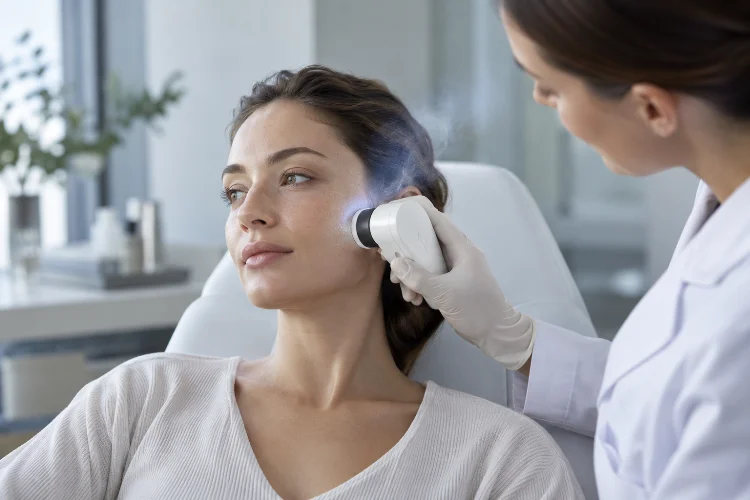
Researchers use specialized instruments containing sensors that measure changes in water vapor above the skin. Open-chamber, closed-chamber, and condenser-based devices are among the approaches used.
The measurement sounds simple, but TEWL is surprisingly sensitive.
Room temperature, relative humidity, airflow, skin temperature, sweating, anatomical location, recent product application, and even the measurement device itself can influence the result.
For that reason, professional studies normally allow participants to acclimatize to a controlled environment before measurements are taken.
There is also no single universal TEWL number that defines healthy skin everywhere on the body. A large systematic review found substantial differences between anatomical sites, with some areas naturally losing considerably more water than others.
So comparing a random home reading with a single internet reference value can be misleading.
TEWL, Dry Skin, and Atopic Dermatitis
TEWL becomes particularly useful when researchers study diseases involving barrier dysfunction.
Atopic dermatitis is one major example. Research shows that barrier abnormalities can occur in both visibly affected and apparently normal skin in people with the condition.
Changes involving structural proteins, epidermal lipids, immune signaling, and other components can contribute to greater permeability and increased water loss.
However, high TEWL does not automatically mean someone has eczema or another dermatological disease.
It is a measurement of barrier function, not a stand-alone diagnosis.
This distinction matters because several completely different factors – from temporary irritation to chronic inflammatory disease – can increase water loss.
Persistent itching, inflammation, cracking, bleeding, or recurring rashes should therefore be evaluated by a qualified healthcare professional rather than diagnosed through TEWL alone.
How to Support a Barrier With Excessive Water Loss
Reducing unnecessary barrier stress is usually more useful than continuously adding stronger skincare products.
Gentle cleansing is a good starting point. Using lukewarm rather than very hot water and avoiding excessive scrubbing can help preserve surface lipids.
Moisturizer is particularly useful after cleansing, when the skin still contains some water. Formulas combining humectants, emollients, and occlusive ingredients can support different aspects of hydration.
Ceramide-containing products may also help support the lipid environment of the stratum corneum, particularly when they are part of a well-designed overall formulation.
Skincare actives should be introduced gradually. Using several exfoliating acids, retinoids, strong acne treatments, and scrubs simultaneously can overwhelm some skin barriers.
A consistant routine is usually more useful than constantly switching products.
And remember that recovery takes time. A compromised barrier is a biological structure undergoing repair, not simply a dry surface waiting for another layer of cream.
Why Lower TEWL Does Not Always Mean “Better Skin”
It can be tempting to treat TEWL like a score where lower is always better.
Reality is more complicated.
Water loss naturally varies between body areas, individuals, ages, environmental conditions, and measurement techniques. Researchers have documented wide ranges even among healthy adults.
Occlusive products can also reduce measured evaporation temporarily without necessarily fixing every underlying component of barrier biology.
For this reason, TEWL is most informative when researchers compare measurements under controlled conditions – for example, before and after treatment on the same area of skin.
In everyday skincare, the practical lesson is not to chase the lowest possible number. Instead, pay attention to signs of improved barrier stability: less tightness after washing, fewer episodes of irritation, smoother texture, and better tolerance of normal skincare.
TEWL simply gives scientists another way to see what may be happening beneath the surface.
The Connection Between TEWL and Long-Term Skin Hydration
Good hydration depends on a balance between water supply and water retention.
Natural moisturizing factors inside corneocytes help bind water, while extracellular lipids reduce how quickly that moisture escapes.
When the barrier becomes increasingly permeable, simply adding hydrating ingredients may create only temporary improvement.
This explains why some people repeatedly apply moisturizers throughout the day yet still experience tightness shortly afterward.
For long-term hydration, the goal is to support both water content and barrier integrity.
That can mean reducing irritation, restoring lipid support, protecting the skin from excessive enviromental stress, and allowing enough time for normal epidermal renewal.
Transepidermal water loss offers an interesting window into skin barrier health because it measures something appearance alone cannot always reveal: how effectively the epidermis is controlling water escape.
When TEWL rises, it may indicate increased barrier permeability caused by irritation, lipid disruption, environmental exposure, inflammatory skin conditions, or other factors.
At the same time, TEWL varies naturally, so one measurement should never be treated as a diagnosis.
For everyday skincare, the bigger lesson is simple. Do not focus only on adding hydration. Protect the structure that keeps moisture inside as well.
Use gentle cleansing, sensible active ingredients, and a balanced moisturizer consistently. If persistent dryness, itching, or inflammation continues, consider speaking with a dermatologist instead of simply adding more products.