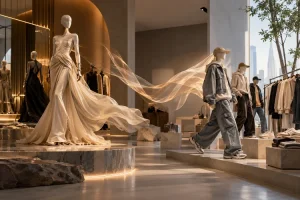


One week, everyone seems obsessed with a specific colour, shoe shape, or oddly specific aesthetic. A few months later, the same trend can feel completely exhausted.
Meanwhile, wider silhouettes, denim shapes, tailoring preferences, or minimalist dressing can evolve for years before disappearing – and often return decades later.
That difference sits at the heart of micro-trends and long-term style cycles.
Also Read
Fashion has always moved through periods of adoption and decline, but digital platforms have dramatically increased the speed at which people discover, imitate, reinterpret, and abandon ideas.
Research into fashion cycles has long distinguished short-run acceptance of individual styles from much longer movements that can unfold across decades.
Today, TikTok, Instagram, influencers, search data, and rapid retail production add another layer. A small visual idea can achieve global visibility before it has developed deep cultural roots.
Understanding that distinction helps brands, forecasters, and consumers separate temporary hype from changes that could reshape wardrobes for years.
Micro-Trends Depend on Speed
Micro-trends are usually defined by rapid adoption and relatively short lifespans.
They may revolve around one specific colour, accessory, styling detail, print, shoe shape, or highly recognizable aesthetic. Social media makes these ideas extremely easy to package, name, share, and reproduce.
A trend does not need years to develop anymore. One celebrity appearance, viral creator, television character, or popular video can generate huge attention almost immediately.
Research on cultural fashion dynamics offers an interesting explanation for this behaviour.
Models developed by Acerbi, Ghirlanda, and Enquist found that traits that increase very rapidly in popularity also tend to decline rapidly, while only a small number achieve widespread and long-lasting adoption.
That creates the basic micro-trend pattern: fast rise, intense visiblity, saturation, and rapid decline.
The same velocity that makes a trend exciting can also shorten its life.
Long-Term Style Cycles Develop More Slowly
Long-term cycles usually operate differently because they involve broader changes in fashion preferences.
Instead of one handbag or viral colour, think about skirt lengths, waist placement, tailoring proportions, denim silhouettes, or the recurring movement between fitted and oversized clothing.
Historical research provides evidence that these elements can change cyclically over very long periods. A study of women’s day dresses between 1860 and 1980 found recurring movements in skirt length, waist emphasis, and overall silhouette.
Fashion theorist George Sproles similarly distinguished between short-run fashion acceptance, which may last months or years, and long-run secular movements developing across decades or even centuries.
That makes long-term cycles less dependent on one viral event.
They can reflect changing lifestyles, generational preferences, cultural attitudes, technology, economic conditions, and reactions against the dominant silhouette of the previous period.
Social Media Gives Micro-Trends an Accelerator
Discovery happens almost instantly
Before social media, consumers generally encountered fashion through stores, magazines, celebrities, television, friends, and seasonal collections.
Today, millions of people can see the same styling idea in a single day.
Social platforms also make fashion participation unusually easy. Users do not simply watch trends; they recreate them, rename them, combine them with other aesthetics, and distribute them again.
Research published in 2025 on fashion trends among younger consumers noted that social-media hashtag culture has played an important role in the development and circulation of micro-trends.
This constant visibility can produce enormous momentun.
But there is a downside. Once everyone has seen a style repeatedly, novelty disappears.
The algorithm that helped create the trend can quickly replace it with another one.
Fast Growth Can Produce Fast Fashion Fatigue
Imagine seeing the same unusual pair of shoes once.
They might feel fresh.
After seeing them 200 times across different creators, ads, retailers, and recommendation feeds, the reaction may completely change.
This is one reason saturation happens so quickly online.
Micro-trends often depend on novelty as part of their appeal. Once widespread adoption removes that novelty, early adopters may immediately begin searching for the next visual difference.
Long-term styles do not necessarily rely on novelty in the same way.
Straight-leg jeans, white shirts, relaxed tailoring, sneakers, and other enduring categories may survive because they are practical, adaptable, or easy to integrate into different identities.
In other words, a micro-trend may ask, “Does this feel new?”
A durable style also has to answer, “Does this continue to work?”
That second question is much harder to satisfy.
Consumer Identity Gives Some Trends Staying Power
Trends become more durable when they connect with deeper consumer needs.
Consider the long-term shift toward casual clothing. Sneakers, relaxed trousers, hoodies, knitwear, and hybrid workwear were not simply one viral aesthetic. They connected with changes in workplace culture, mobility, comfort expectations, streetwear influence, and everyday lifestyles.
These broader behavioral forces give a style more structural support.
Fashion-cycle research treats fashion as part of continuing cultural change rather than simply a sequence of isolated product launches.
This explains why two visually popular ideas can follow completely different trajectories.
One might generate huge engagement because it is entertaining or unusual. Another may receive less spectacular attention but slowly become part of everyday wardrobes.
Long-term preferance usually develops when a style can adapt to different consumers rather than depending on one narrow aesthetic identity.
Retailers Treat the Two Types of Trends Differently
Micro-trends create a difficult commercial problem.
If a retailer reacts too slowly, demand may already be disappearing by the time products reach stores. If it orders too much inventory, yesterday’s viral product can quickly become tomorrow’s markdown problem.
This is why social and search data have become valuable for fashion-demand forecasting.
Research involving three multinational retailers found that detailed social-media and Google search information improved forecasting of colour and jeans-fit demand months before the selling season.
Out-of-sample forecasting improvements over existing practice ranged from 24% to 57% in the study.
Long-term style changes allow somewhat different planning.
A gradual movement toward wider trousers, for example, can affect several seasons of product development rather than requiring a one-time bet on one viral item.
Brands can adjust proportions progressively across collections.
Understanding the type of trend therefore influences sourcing, inventory, merchandising, marketing, and production quantities.
Long-Term Cycles Can Return in New Forms
Fashion’s habit of returning to the past is another major difference.
A micro-trend may disappear almost completely when its novelty expires. Long-term silhouettes, however, frequently return because new generations reinterpret them.
The return is rarely an exact copy.
A 1970s-inspired flare may use modern stretch fabrics. A 1990s minimalist look may be combined with current footwear and technology. A 2000s silhouette can return with different proportions and cultural associations.
Historical studies of fashion cycles support the idea that significant clothing characteristics can recur over long periods.
Fashion therefore behaves partly like a pendulum.
When one silhouette becomes dominant for long enough, its opposite can start to feel fresh.
After years of extremely slim clothing, oversized proportions may feel modern. After oversized styles dominate, sharper fitted shapes can regain appeal.
That recurring contrast gives major style cycles a much longer history than most internet aesthetics.
Influencers Can Connect Runways, Consumers, and Retail
The distinction between micro and long-term trends is not always clean.
A small trend can sometimes develop into something bigger when it moves through several parts of the fashion ecosystem.
Recent research comparing runway imagery, influencer outfits, and popular products sold by online retailers found meaningful relationships between these different trend-information sources.
The study highlights the growing role of influencers in connecting high-fashion information with mass consumer markets.
This creates an important signal for forecasters.
If an aesthetic exists only among a few viral creators, it may remain a micro-trend.
If the same underlying direction begins appearing in runway collections, influencer styling, search activity, retail assortments, and consumer purchases, something more substantial may be developing.
The key is cross-market confirmation.
Durable trends usually build support from more than one channel.
Micro-Trends Create More Inventory Risk
Fashion is already difficult to forecast because products have short selling periods, long production lead times, and constantly changing demand.
Micro-trends intensify that problem.
Social media can make a product desirable before traditional supply chains can respond.
McKinsey has noted for years that consumers can now discover and share trends almost instantly, while brands increasingly need faster design-to-shelf processes and better consumer data to respond.
The broader industry remains volatile today. McKinsey’s 2026 fashion outlook describes rapidly changing technology and consumer priorities as part of a fashion environment where companies increasingly need agility.
For retailers, this makes trend classification extremely useful.
A micro-trend may justify small quantities, rapid testing, or limited drops.
A structural style movement may justify deeper investment across multiple seasons.
Treating both identically can create expensive mistakes.
How Forecasters Separate Hype From a Real Style Shift
No single metric can tell forecasters whether a trend will last.
Millions of TikTok views are useful evidence of attention, but they do not guarantee sustained demand.
Forecasters therefore look for multiple signals.
They may track how quickly adoption grows, how many different communities embrace the idea, whether searches continue rising, whether consumers actually buy related products, and whether the trend can evolve into multiple product categories.
They also look for cultural relevance.
Does the trend connect with changes in work, identity, economic conditions, music, technology, sustainability, comfort, or generational behaviour?
If the answer is yes, the trend may have deeper roots.
A consistant pattern across social media, retail, search behaviour, runway direction, and consumer lifestyle is much more convincing than one explosive viral spike.
The strongest forecasting question is therefore not “How popular is this?”
It is “What is keeping this popular?”
Micro-trends behave differently from long-term style cycles because they are built on different types of momentum.
Micro-trends often depend on novelty, social-media amplification, rapid imitation, and high visibility. They can explode quickly but disappear just as fast once consumers become saturated.
Long-term cycles develop more gradually and are often supported by deeper changes in culture, lifestyle, identity, functionality, and generational taste.
For brands and forecasters, separating the two is essential. Viral attention alone should never determine major inventory decisions.
Watch how long interest lasts, which communities adopt the idea, whether consumers actually buy it, and whether the style can evolve beyond one recognizable look.
The difference between a three-week aesthetic and a decade-long shift often lies beneath the hype.