
Some of the most effective skincare ingredients are also surprisingly difficult to formulate.
Retinol can degrade when exposed to light, oxygen, and heat. Vitamin C can lose activity through oxidation. Botanical antioxidants may be poorly soluble or unstable once removed from the plant environment that originally protected them.
This creates a major challenge for cosmetic formulators. An ingredient may look impressive when added to a product, but what really matters is how much remains stable and available when someone actually applies that product months later.
Also Read
That is where encapsulation in advanced skincare formulas becomes useful.
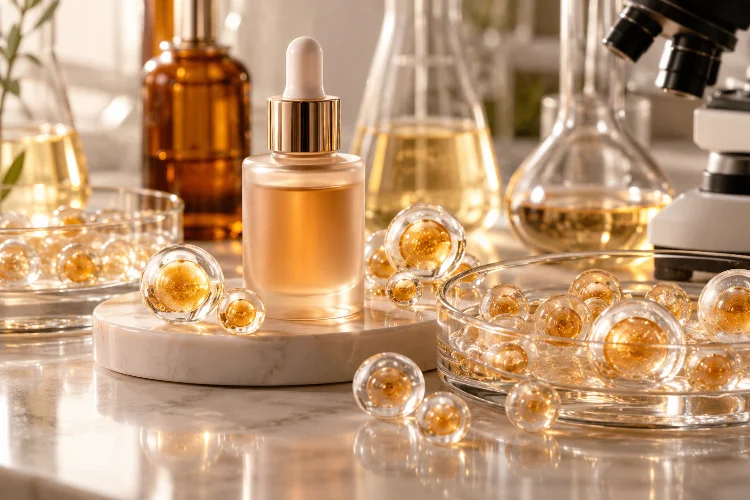
Instead of leaving a sensitive active fully exposed to the surrounding cream or serum, formulators can package it inside microscopic or molecular carriers.
These systems may protect the ingredient, improve solubility, control its release, and reduce unwanted interactions with other components.
Encapsulation does not automatically make a product superior, but when it is designed correctly, it can solve some of the biggest stability problems in modern cosmetic science.
Why Skincare Actives Lose Stability
Before understanding encapsulation, it helps to understand what skincare ingredients are fighting against.
A cosmetic formula is chemically active even while sitting untouched on a bathroom shelf. Oxygen may enter through packaging, light can trigger photochemical reactions, and higher temperatures can accelerate degradation.
Water, pH, metal ions, surfactants, fragrances, botanical extracts, and other ingredients can also interact with sensitive compounds.
Retinoids are a good example. A study examining commercial cosmetic products found considerable formulation-dependent degradation over six months, with losses becoming especially pronounced under elevated temperatures.
Light exposure also caused substantial deterioration. This means the concentration added during manufacturing is not the only number that matters.
A 1% active that rapidly degrades could eventually deliver less usable material than a lower concentration protected inside a well-designed delivery system.
Encapsulation Creates a Protective Microenvironment
The basic idea behind encapsulation is fairly simple: isolate an active ingredient from at least part of its surrounding environment.
The active may be trapped inside a lipid vesicle, solid particle, polymeric shell, molecular cavity, or another carrier system. This microscopic barrier can reduce direct contact with oxygen, water, light, or incompatible ingredients.
Think of it like storing delicate food inside protective packaging rather than leaving it exposed on the kitchen counter.
The exact level of protection depends on the shell material, particle architecture, active ingredient, manufacturing method, and final formula.
Encapsulation technology can also be designed so that an active is released after rubbing, diffusion, changes in pH, dissolution, heat, or degradation of the carrier itself.
This gives formulators more control over both stablity and delivery.
Liposomes Can Protect Sensitive Actives
How lipid vesicles work
Liposomes are microscopic vesicles made from phospholipid bilayers. Because they contain both an aqueous interior and lipid regions, they can carry a wide range of hydrophilic and lipophilic ingredients.
They have been studied extensively for cosmetic antioxidants, vitamins, plant compounds, and other active ingredients.
One advantage is that the bilayer can reduce direct exposure of encapsulated molecules to the external formula. Liposomal systems may also influence how slowly an ingredient is released after application.
Retinol provides a useful example.
Experimental research has shown that incorporating retinol into phosphatidylcholine vesicles can slow degradation compared with unencapsulated retinol under certain storage conditions.
Additional antioxidants and modifications to the liposomal membrane can improve protection further. However, liposomes themselves are not perfectly stable.
Their phospholipid membranes can oxidize, leak, fuse, or aggregate. Formulators therefore need to stabilize both the active ingredient and the carrier protecting it.
Lipid Nanoparticles Add Another Layer of Protection
Solid lipid nanoparticles, or SLNs, use a solid lipid matrix rather than the flexible bilayer found in conventional liposomes.
An active ingredient can become embedded inside that matrix, physically reducing its exposure to the surrounding environment.
Nanostructured lipid carriers, or NLCs, take the idea further by combining solid and liquid lipids.
The less perfectly ordered structure can provide more space for active ingredients and may reduce the tendency for some molecules to be expelled as the lipid structure changes during storage.
These technologies have been investigated for both cosmetic and dermatological applications because they may provide ingredient stabilisation, controlled release, film formation, and local skin delivery.
Recent retinol research provides a practical illustration. Lipid nanocarriers have been developed specifically to reduce oxidation of retinol exposed to air while improving its thermal stability.
The important point is not that “nano” automatically means better. Performance still depends on lipid selection, particle size, crystallinity, surfactants, manufacturing conditions, and the surrounding formulation.
Cyclodextrins Protect Ingredients at the Molecular Level
Not every encapsulation system looks like a microscopic sphere floating through a cream.
Cyclodextrins work at an even smaller molecular scale.
These ring-shaped carbohydrates have a relatively water-friendly exterior and a cavity capable of hosting certain hydrophobic molecules. When an ingredient fits into this cavity, it forms what scientists call an inclusion complex.
This can change the ingredient’s behaviour dramatically.
Research has shown that cyclodextrin complexation can improve the solubility and chemical stability of suitable cosmetic ingredients while offering protection against factors such as oxygen or light.
Modern reviews discuss their potential with vitamin A derivatives, vitamin C-related ingredients, coenzyme Q10, kojic acid, arbutin, botanical molecules, and UV filters.
But molecular compatability matters. Not every active fits effectively into every type of cyclodextrin, so carrier selection has to be based on chemistry rather than marketing terminology.
Encapsulation Can Make Vitamin C Easier to Formulate
Vitamin C shows why stability technology matters so much in skincare.
L-ascorbic acid is valued for antioxidant activity but is notoriously challenging to keep stable. Oxygen, water, temperature, light, and formulation conditions can contribute to degradation.
Traditional approaches include controlling oxygen exposure, maintaining an appropriate pH, reducing water content, using antioxidants, or choosing more stable vitamin C derivatives.
Micro- and nanoencapsulation offer another strategy.
A scientific review of vitamin C delivery notes that liposomes, nanoparticles, microemulsions, and related systems have been investigated specifically to improve both stability and delivery.
This does not mean every encapsulated vitamin C serum will remain perfect indefinitely.
Packaging still matters. Airless pumps, opaque containers, proper storage temperatures, antioxidant systems, and the rest of the formulation must work together with the delivery technology.
Encapsulation is one part of the stability strategy – not a replacement for good formulation.
Controlled Release May Reduce Stress on the Skin
Protecting an active inside the bottle is only half the story.
Encapsulation can also control what happens after the product reaches the skin.
Instead of releasing the entire available concentration immediately, some systems act as reservoirs that gradually release their contents over time.
This approach can be particularly interesting for powerful ingredients such as retinoids.
In one study, researchers developed silicone particles capable of encapsulating retinol with greater than 85% efficiency. The encapsulated retinol showed a reported half-life nine times longer than unencapsulated material, while the system also provided slower release.
Controlled release may sometimes reduce the sudden exposure responsible for irritation while preserving useful activity.
However, slower is not automatically better either.
The ideal release profile depends on the ingredient, concentration, skin target, application frequency, and desired biological effect.
Encapsulation Can Prevent Ingredients From Interacting Too Soon
Advanced formulas often contain many active ingredients in the same bottle.
That creates opportunities for unwanted chemical interactions.
One antioxidant may react with another ingredient. A fragrance molecule may interfere with an active. Certain compounds require different pH environments, while others become unstable around water or particular ions.
Encapsulation can physically isolate an ingredient from some of these surroundings until application.
This gives formulators more flexibility when combining compounds that would otherwise be difficult to keep stable together.
It can also help with practical cosmetic problems such as unpleasant odor, poor solubility, volatility, or discoloration.
Cyclodextrins, for example, have long been studied for their ability to reduce volatility and modify undesirable physical properties of encapsulated molecules.
This is one reason modern delivery technology influences more than clinical performance. It can also improve how a product looks, smells, feels, and survives storage.
Encapsulation Does Not Guarantee Shelf Stability
Seeing the words “encapsulated retinol” or “liposomal vitamin C” on packaging should not be treated as proof that a formula is stable.
The carrier itself has to remain intact.
Particles can aggregate. Liposomes can leak. Lipids can oxidize. An active may migrate out of the carrier, crystallize, or react with another part of the formula.
Manufacturing conditions are equally important.
Particle size distribution, encapsulation efficiency, processing temperature, homogenization, raw material quality, preservatives, antioxidants, packaging, and storage conditions can all influence the result.
Even sophisticated liposomal systems have known stability limitations, which is why researchers continue to investigate coatings and other ways of strengthening their structure.
Real stability testing therefore remains essential.
A technically impressive delivery system means little if the finished serum separates, oxidizes, or loses most of its active ingredient before its expiration date.
Why the Finished Formula Matters More Than the Buzzword
Modern skincare marketing loves impressive terminology.
“Microencapsulated,” “nano-delivery,” “liposomal,” and “time-release” can all sound advanced – and they genuinely represent useful scientific technologies.
But the name of the carrier does not tell you how well it was designed.
Two retinol products can both use encapsulation while having completely different particle structures, release rates, antioxidant systems, packaging, concentrations, and long-term stability.
Consumers usually cannot determine all of this from an ingredient list.
The more meaningful signs are good formulation design, appropriate packaging, credible stability testing, realistic product claims, and evidence on the finished formulation whenever available.
A consistant skincare routine using a stable, well-formulated product is generally more useful than chasing the most complicated delivery technology on the market.
Encapsulation can make advanced skincare formulas more reliable by protecting fragile ingredients from oxygen, light, heat, water, and unwanted chemical interactions.
Technologies such as liposomes, lipid nanoparticles, cyclodextrins, and polymeric carriers can also improve solubility and create controlled-release systems.
But encapsulation is not magic packaging at a microscopic scale. The carrier, active ingredient, surrounding formula, manufacturing process, and final container all have to work together.
When comparing skincare products, look beyond the phrase “encapsulated active.” Consider why the ingredient needs protection, how the delivery system supports it, and whether the finished formula has evidence behind its stability.
In advanced cosmetic science, protecting an ingredient until the moment it is needed can be just as important as choosing the ingredient itself.